
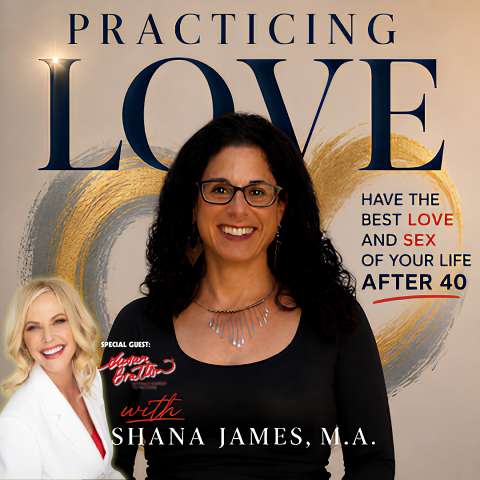
I recently joined relationship coach and author Shana James on her Practicing Love podcast for a candid conversation about something I’ve devoted decades of my life to: creating relationships where we can be fully known, deeply desired, and genuinely loved.
Shana’s work is rooted in an idea I wholeheartedly appreciate—that great relationships don’t simply happen. Love is a practice.
For more than 20 years, she has helped singles and couples communicate more honestly, rebuild trust, deepen intimacy, and reignite desire without losing themselves in the process. On Practicing Love, she brings those conversations into the open, inviting guests to share vulnerably about what it really takes to keep love alive.
This is especially important for those of us navigating dating after 40, midlife relationships, life after divorce, or a long-term partnership where the spark has started to dim.
It’s intentional, emotionally aware love—practiced again and again.
And that made Practicing Love the perfect place for our conversation.
What If Her Desires Aren’t Something to Fear?
One of the things Shana and I explored is a dynamic I’ve witnessed again and again: most men were never taught how to navigate a woman’s desires.
In many cases, they were actually taught to fear them.
When a woman expresses what she truly wants, a man may hear it as criticism: I’m not doing enough. I’m not satisfying her. I’m getting this wrong.
But what if her desires aren’t a judgment?
What if they’re a roadmap?
When a woman feels safe enough to share what she wants—and when her partner can receive those desires with curiosity rather than defensiveness—something beautiful becomes possible.
They stop trying to read each other’s minds.
They stop performing.
They start co-creating.
That’s where intimacy gets really interesting.
Conscious Lovemaking vs. Performative Sex
I often describe the kind of intimacy I teach as heart-connected, conscious, passionate lovemaking.
That’s very different from performative sex.
Performative sex happens when we’re focused on doing everything “right.” We’re thinking about techniques, outcomes, how we look, whether our partner is satisfied, or whether we’re measuring up to some imaginary standard.
Conscious lovemaking brings us back to each other.
It’s about presence.
It’s about self-expression.
It’s about emotional safety.
And perhaps most importantly, it’s about telling the truth.
Great intimacy isn’t a performance you perfect. It’s an experience you create together.
Asking for What You Want Is a Gift
Many women have spent years—even decades—learning to minimize their desires.
We don’t want to be “too much.”
We don’t want to hurt our partner’s feelings.
We worry that asking for something different means telling our partner they’ve failed.
So we stay quiet.
But one of the most powerful ideas Shana and I discussed is that asking for what you want can be one of the greatest gifts you give your partner.
When you lovingly and clearly express your desires, you’re giving your partner the opportunity to know you more deeply.
And being known is one of the foundations of intimacy.
This goes far beyond the bedroom.
Healthy relationships thrive when both people can say: This is what I feel. This is what I need. This is what I desire. This is what would make me feel even closer to you.
Then the relationship becomes a collaboration instead of a guessing game.
Stop Controlling. Start Co-Creating.
Another theme we explored was what happens when partners stop trying to control one another.
Control often sneaks into relationships disguised as protection. We try to manage our partner’s reactions. We avoid certain conversations. We suppress desires. We anticipate what will upset the other person and edit ourselves accordingly.
Over time, we can become less and less visible to each other.
Co-creation asks for something different.
It asks: What can we make together that honors both of us?
That mindset can completely change the way couples approach communication, intimacy, pleasure, and desire.
You’re no longer opponents negotiating over whose needs matter more.
You’re partners discovering what’s possible together.
Heart Connection Changes Everything
For me, physical intimacy and emotional intimacy have never been separate conversations.
Heart connection makes intimacy richer.
When I feel emotionally safe enough to reveal myself—to share my desires, my vulnerability, my curiosity, my pleasure—I have more of myself available to bring into the relationship.
The same is true for my partner.
That openness creates an intimacy that technique alone simply cannot manufacture.
During my conversation with Shana, I shared stories from my own life and relationships, as well as lessons I’ve gathered through decades of teaching about intimacy and partnership.
Some of our conversation is refreshingly direct and very adult.
But beneath all of it is a much bigger invitation.
How Long-Term Love Stays Alive
Long-term relationships don’t have to become passionless.
Desire doesn’t have to disappear simply because you’ve been together for years.
But keeping a relationship erotic, connected, and alive requires our participation.
We continue discovering each other.
We keep communicating.
We allow ourselves to evolve.
And we create enough safety for our desires to evolve too.
Your partner today is not exactly the person you met five, ten, or twenty years ago.
Neither are you.
There is something incredibly exciting about approaching a longtime partner with curiosity and asking: Who are you now? What do you want now? What would feel wonderful now? What can we discover together?
That curiosity keeps us from assuming we already know everything there is to know about each other.
And it gives desire room to breathe.
Fully Known. Fully Loved.
Ultimately, this episode of Practicing Love is about much more than better sex.
It’s about having the courage to stop performing.
To stop hiding.
To stop expecting our partners to magically know what we want.
And to start telling the truth—with love.
Because the relationships I want us to create are relationships where we don’t have to shrink ourselves to remain connected.
They’re relationships where desire can be spoken openly, where curiosity replaces judgment, and where two people continually learn how to love each other better.
Fully known. Fully expressed. Fully loved.
If you’ve been wondering how to create deeper connection, more satisfying intimacy, or a relationship where you can talk openly about what you truly desire, I think you’ll get a lot from my conversation with Shana James on Practicing Love.
I hope you’ll listen—and that afterward, you’ll bring one question back to your own relationship:
What do I truly want, and am I willing to lovingly let my partner know?